
Aegeapolis
Être prévenu du lancementStatut actuel
À venir
Aegeapolis is played on two levels: the board and the people around the table.
An open Greek polis world — a sandbox, not a retelling — with eleven historical details built into it, the kind connoisseurs notice and beginners do not have to. It is set in the first phase of the Peloponnesian War, 431 to 421 BC.
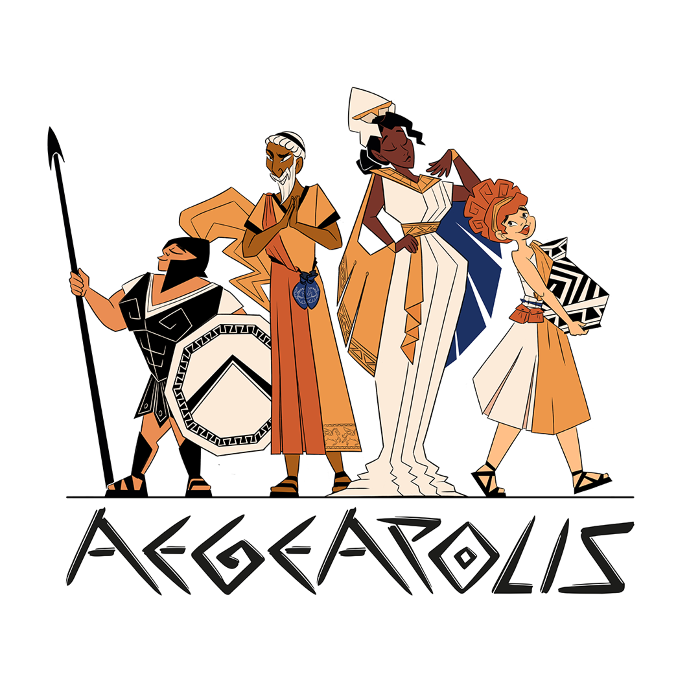
In the same box: a campaign mode where the story comes first. Four characters carry it — Athene the arrogant strategist, Leonidas the proud warrior, Sisyphos the cunning trader, and Phix the vase painter who is always in a hurry.
Two to four players, ages 14 and up, around two and a half hours.
Two levels: the board and the table
Aegeapolis asks you to read two things at once: the board, and the person sitting on the other side of it.
Trade is where this becomes concrete. A trade always runs between two connected poleis, and it generates resources on the spot — nothing is hauled along the road. Trade with another player, and both sides come away with something.
What connects them is a chain of trade links, and the whole network has to hang together back to your Native Polis — but neither side has to trade out of its home city. Single links along the way can belong to other players.
Your route may pass through a polis another player controls, or across a trade link they built. That player can forbid the trade, or ask a concession — an open negotiation over resources, cards or promises, never a fixed toll.
So a trade that looks like a two-player deal can turn into a three-way negotiation the moment a third player owns a piece of the road. That is not a special rule added on top to create drama. It comes out of the map itself.
Everyone opens their hand at the same time
Six times over the eleven game years, the coin ranking is scored. Here is how:
Each player reaches behind their screen and takes coins from their own stock into a closed fist. Nobody can see how many, or from which mints — the cities that struck them. All fists go to the middle of the table. Then a countdown: three, two, one. Everyone opens their hand at the same moment.
The ranks are handed out by how much you committed — first, second and third all score, and a tie shares the better rank. Then the invested coins leave your inventory — minted coins go back into the bag, unminted ones go to the edge of the board. You do not get them back, and the scoring comes around just six times in eleven years.
So the fist is not a snapshot of what you have saved up. It is one single chance. You have to decide how much of your economy to spend on a rank, while guessing what everyone else is holding.
What you actually do on your turn
One action per turn, chosen from seven: discover a new polis tile, build a trade link, trade, recruit, move and fight, take a mission card, or change your form of government.
Three forms of government are available — monarchy, democracy, aristocracy — the classical triad of Greek political thought. Each one favours a different way of playing.
Monarchy gives you a King: the phalanxes on his tile hit on 2–6 instead of 3–6, a margin that compounds through long battles — but the King has to march with the army. Aristocracy adds heroes when you recruit and rewards small and mid-sized engagements. Democracy pays you an extra unminted coin on every trade.
Switching costs you an action. Switching back to aristocracy reactivates the heroes you had.
Four factions, four signature abilities
Athens, Sparta, Corinth, and Thebes — Athene, Leonidas, Sisyphos, and Phix — each bring one signature ability. Athens places two extra phalanxes in a polis it has just taken. Sparta's dice replace any rolled die and each hit counts twice, and Sparta banks its own combat losses, trading two of them back in for one more Spartan die. Corinth gets an eighth action: recruiting Builders, who raise fortifications out on the board each winter. Thebes can activate the oblique order — massing its strength on one wing — three times per game, for four extra dice, attacking or defending.
The factions are not four fixed playstyles. Your path to victory is shaped first by the mission cards you draft, then by which poleis you take, and only then by your faction. All four can be played toward the coin economy, toward map control, or toward a card-driven mix of both. They only make some paths easier than others.
Two modes, one box
Sandbox is the demanding one: eleven years, negotiation, hidden coin stocks, and a 5×5 grid at four players. Thirty points ends the game, and the highest total wins it. You don't have to start at full weight. Leave out the mission cards and the governments, or play head to head, and add each layer once the last one feels natural.
Campaign puts the story first. Three concepts: Colonization as a 2-vs-2 with a partner, King of the Hill with a defender against attackers, and Emporion — a trading hub — built around coin combinations and collecting. Colonization already has three worked-out scenarios. King of the Hill and Emporion are designed as concepts, with playable scenarios to follow.
Both modes are in the same box. No surcharge, no expansion. The sandbox stands on its own — the campaign grows together with the backers.
The coins
The resource system runs on coins, and they carry the history.
Eight cities in the game minted their own coins in the Archaic and Classical periods: Abydos, Aegina, Argos, Corinth, Megara, Milet, Rhodes, and Thera. Each one has its own minted design, and coins from a city only count in the mint ranking while you hold that city.
If you lose the city, the coins stay useful for everything else — trades, mission cards, the regular coin ranking. But you lose that one way to score, until you take the city back.
There are no miniatures in this game — the characters live on the player screens and in the campaign book.
Who is making this
My name is Oliver Vogeler, and I design Aegeapolis in Cologne, Germany.
Admira Games started in 2023 as a partnership with Jonas Küttner. On 1 January 2025 I founded it again as a solo studio. Aegeapolis came out of our earlier work between 2021 and 2023, and it has been a one-person project since then.
My fascination with antiquity is older than the game. My mother owned an atlas of the world, and as a child I studied those maps and built the stories in my head. I later studied history in Cologne, with ancient history as a minor — Greek antiquity and Aristotle's Politics were the private obsession — before studying applied computer science.
What I have learned designing this: it is not about having lots of great ideas. It is about simplifying the ones you have. The game started with roughly fourteen resource types. It now runs on coins, and it got better every time I took something out.
Julia Bender is the only artist on Aegeapolis — cover, characters, component layouts. One artist, one visual voice. Every image in the game came from a human hand — no AI, no generated art.
I also work three days a week as a software developer. This is a solo studio with a day job.
Where the project stands
The rules are written in English and German. Prototypes are in playtesting, and the production partner is chosen — Gameland in China. I met Ellie, my contact there, at SPIEL Essen in 2025.
Aegeapolis will be at SPIEL Essen in October 2026, where you can sit down and play it. The campaign launches on 2 March 2027.
Between now and then: finished artwork, more playtesting, and review copies sent out.
Follow, and you will hear from me once
Press the follow button and you will hear from me when the campaign goes live, and not more often than that.
If you want more than that, I write a monthly newsletter about the design decisions as they happen, including the ones I got wrong. You can sign up at aegeapolis.com/dispatch.
Images (12 · BoardGameGeek)
▶ Vidéos (0)
Pas encore de vidéo pour ce jeu.
Commentaires (0)
Connecte-toi pour commenter ou répondre.
Pas encore de commentaire. Lance la discussion.